Thursday, March 20, 2025

We need to stop catastrophizing when we're cliff jumping

Catastrophizing is imagining the worst possible outcome of an action or event and treating it as a likely outcome even when it is not. 

This phenomenon may be associated with reduced behavioral measures of risk-taking. What is interesting about the relationship between catastrophizing and risk-taking is how these somewhat conflicting experiences play a role in the decision-making of many "first and onlys." In First Gen A Memoir, Campoverdi discusses her decision to take out massive loans to attend Harvard as a form of risk-taking comparable to "Blindfolded Cliff Jumping." First and onlys face difficult choices with extremely high stakes since they are less likely to have family financial support, built-in professional networks through families, or savings (165). 

While most first and onlys understand taking risks is inherent to their identities as being the first or only ones in their family to break into certain spaces, this challenge is often coupled with catastrophization. On the one hand, risk-taking is necessary for our growth, but on the other, we are raised to be attuned to the consequences of our actions and to work hard to avoid failure. We are used to having to prove we are worthy of being in such spaces since we cannot point to our family members as proof of our credibility. As such, this is why so many first and onlys are very susceptible to imposter phenomena.

This is where catastrophizing comes in. When analyzing choices we can make in life, the stakes are so high that before "diving straight off these cliffs," we tend to overanalyze and imagine every possible outcome of our actions. In my experience, when I have been at a crossroads in my life, I catastrophize the different options I have in order to mentally prepare myself for the consequences of my own actions. As Campoverdi states, “Those who smash through glass ceilings are then left to clean up the shards on their own.” In this way, catastrophizing prepares me to clean up the shards after myself because even when we achieve milestones, they come at a cost, like the loneliness we feel in no longer relating to those in places we came from.

Catastrophizing, where we often assume the worst in people and situations, buffers possible disappointment. It can also help protect us by preparing for anything that could go wrong. For example, because I catastrophized the possibility of not getting a single job offer for my 2L summer, I was motivated to apply to every job opening available, regardless of my interests. I had prepared for the worst, so when I did get an offer, nothing made me happier. If I had not gotten an offer, I would have expected it and would have been prepared to act accordingly because I had "planned ahead" for the disappointment.

When I found myself being the only person of color waitressing at a country club, I catastrophized dealing with racism among my coworkers and even customers. If I did not face any racism, I was pleasantly surprised. However, because I did, I was more emotionally prepared for these encounters because I had "planned ahead" for them. Talking to fellow first and onlys, I know I am not alone in these thoughts and experiences. 

Despite the comfort catastrophizing can bring us, assuming and preparing for the worst in every situation distorts our sense of reality and can increase our risk of mental illnesses by contributing to various anxiety disorders. It is very difficult to break this unhealthy way of thinking, though, especially as first and onlys, because it is a coping mechanism. Luckily, many tips and resources are available to help us break these cycles.

Some methods I have found helpful in my journey to stop catastrophizing include various forms of self-care. I enjoy gratitude journaling, as cheesy as it sounds, since it helps ground me in the present moment instead of worrying so much about the future. Learning that the brain cannot respond to anxiety and gratitude simultaneously makes this technique extra helpful in diminishing catastrophization. Thinking about all the things in my life I am grateful for minimizes negative thoughts I have about the future. Additionally, when I allow myself to do the things I enjoy — like exercising, getting out in nature, and spending time with loved ones — my problems feel less significant, and I become more self-compassionate. 

As first and onlys, we often work so hard to prove wrong the limiting beliefs society places on us that we adopt behaviors that are unkind to ourselves. We forget to break negative habits because they may have helped us in the past. This is a reminder to myself and my fellow first and onlys that to truly love ourselves and improve our well-being, we must stop the catastrophizing that so often accompanies cliff jumping.

My little friend to remind us to love ourselves and to stop catastrophizing because everything will work itself out.

Labels: , , , , ,

Tuesday, March 4, 2025

What my eight-year-old sister taught me about imposter syndrome - integrity, discipline, and the excitement to try again

I struggle with the fear of not knowing enough. I struggle with the possibility of failure and the fear of not being able to hold my own hand through it. I struggle with imposter syndrome.

When you’re the first to do something, the first in your family to go to college, the first to step into a career path, you carry the weight of uncertainty. You walk into rooms where no one looks like you, where no one seems as flustered as you, and where everyone appears to have a roadmap but you. There is no familiar voice to turn to for reassurance, no safety net of lived experience to tell you, “Yes, this is how it works!” or “You’re doing the right thing.”

Psychologists Pauline Clance and Suzanne Imes, who first coined the term impostor phenomenon, described it as the persistent fear of being exposed as a fraud despite evidence of success. Their research showed that many high-achieving individuals, particularly women, lived in a constant state of self-doubt, convinced that their achievements were due to luck or deception rather than ability.

This post by Anjali Mistry explores the impact of impostor syndrome on women in the workforce, particularly in law, and the role of mentorship in overcoming self-doubt.

For me, that persistent fear is all too familiar. And yet, the thing that has cured my imposter syndrome time and time again is the perspective of an eight-year-old girl who means the world to me—my little sister, Shandiin. Her name is Navajo for sunshine, and she is exactly that: a warm, comforting light, illuminating a path forward.

For an eight-year-old, she carries a lot of fear. She gets anxious about being late. She is reluctant to try new foods. She is scared of failure, as most kids are. But the remarkable thing about her isn’t her fear, it’s what she does despite it.

Recently, she competed in her first taekwondo tournament. It was a huge deal because she was new to the sport. My parents recently moved from Texas to California. In Texas, she took karate, but taekwondo is different. Different forms, different goals, different stances. Yet in just six months, she embraced an entirely new discipline.

I love watching her practice because I can see how much she wants it. She is a typical energetic, silly kid, always joking and playing. But in practice, she is different. She stands still, listens intently, absorbing every movement her instructors make. She isn’t just present—she is studying. And before we knew it, she had won her studio’s award for integrity.

During class, when the kids were told to complete their moves and sit when finished, some sat down early, following the crowd. But not Shandiin. It didn’t matter if she was the last one standing—she completed every move to fruition. She wasn’t afraid of being slower because she was focused on doing it right.

Her integrity and discipline is why she was chosen for the tournament training team despite being new to the sport. 

But she was hesitant to join. She didn’t know what a tournament looked like. She didn’t know if her skills matched up. No one in our family had ever done taekwondo, so we had no wisdom to pass down.

Sound familiar? It’s the first-gen experience in a different form.

You step into spaces where no one before you has gone. There’s no advice to lean on, no “this is what I learned” to guide you. You study those around you, listen closely, and try to decipher the unspoken rules. You wonder if you belong. You wonder if you’ll be good enough.

But then, you show up anyway.

That’s what Shandiin did. When she came home from her tournament after placing third, she wasn’t most excited about her medal—she was excited to try again. She went on and on about the next competition, about how she had observed the sparring category, one she had been hesitant to try, so she could be more familiar with it next time. She was already thinking about what she would do differently.

She wasn’t discouraged by her inexperience. She was making a plan to tackle a challenge instead of giving up on herself. And the next week, she was back at practice. Same energy. Same drive. Same willingness to learn.

Watching her, I realized: this is how you beat imposter syndrome, in tournaments and in life.

You don’t count yourself out because you’re afraid of being inexperienced. You don’t let the unknown stop you. You step in, watch, learn and try. You might fail, but that’s just an opportunity to learn and try again with new knowledge and perspective.

This post by SC also discusses challenging your feelings of uncertainty to learn and grow.

And when you do, you don’t just shine a path for yourself — you make it easier for those who come next.

Shandiin isn’t just teaching me some of her taekwondo moves in our living room. She’s teaching me how to step into the unknown and see it as an opportunity to grow. She is teaching me how to trust myself even when I don’t have all the answers. She is showing me that the best way to defeat imposter syndrome is with integrity, discipline, and the excitement to try again.

Labels: , , , ,

Saturday, February 8, 2025

Looking through the glass window: the first-generation experience

I am a first-generation law student. Technically, I wasn’t a first-generation college student as my mom attended college and nursing school online when I was a kid, and my dad earned his degree just a few years ago. But in many ways, I still shared the first-generation experience.

Both of my parents pursued their education later in life after I was born. My mom juggled nursing school while raising three kids, often on her own while my dad was deployed with the U.S. Army. My dad, too, worked tirelessly to build a career, and just last year, he was promoted to Sergeant Major while simultaneously earning his master’s degree. Watching them push forward, despite the odds, left a lasting impact on me.

My parents were teen parents. College and careers weren’t something they had been raised to think about and they were the least of their parents’ worries. But they were smart students, great athletes, and heavily involved in extracurriculars. They practically raised themselves before raising three kids and eventually, a fourth, born 11 years later in 2016.

They broke generational cycles: poverty, alcoholism, and the expectation of staying in the same place. But breaking cycles isn’t just about moving forward; it often comes with hard choices. Both of my parents are Native American from different tribes, and they met at a powwow. Being Native comes with deep ties to the land, community, and traditions. 

But as my parents built a better life for themselves, they moved farther from their reservations and the people they grew up with. Their success wasn’t always celebrated with some family members seeing their new lifestyle as my parents thinking they were “better” now that they had financial stability. They were often asked for money, as if they owed it. But when they were teenagers, pregnant and struggling, no one was there to guide them. No one told them what was best for their future. They had to figure it out on their own.

In First Gen: A Memoir, Alejandra Campoverdi talks about those referred to as “First and Only” defined as the first or only person in their community to cross a significant threshold. But with that comes what she calls the Trailblazer Toll. One part of that toll is breakaway guilt that develops with the feeling of having to prove your family’s sacrifices were worth it while grappling with the reality of having more financial security than your loved ones.

This post by AKJ discusses breakaway guilt and the trailblazer toll in more detail. 

I felt that tension growing up watching as my parents created a future they never had, while also seeing the weight they carried because of it. Now, as a first-generation law student, I carry that same drive. My parents always believed in my future, and college was always part of the plan. 

But they couldn’t provide much guidance on the hidden curriculum—the unwritten rules of higher education. They didn’t know about applications, campus life, or preparing for in-person classes. I like many first gen students learned those things from TV shows, movies, online research, and the occasional tip from a friend’s parent who had been to college. My mom only considered college because her wealthier friends were encouraged to apply. Without that push, she may have never pursued nursing.

This post by SC goes into depth on the struggles often faced by first gens new to a college environment. 

I had that encouragement, but in many ways, I felt like I was looking through a glass window—seeing the possibilities but unsure how to reach them. The first-generation experience doesn’t disappear in one generation. Even as one generation makes it better for the next, the effects linger.
Campoverdi notes that “there are thousands of people in each of our family lineages, and their emotional experiences leave a mark on us.”

 As a Native American, I often reflect on my ancestors and the trauma they endured. My great-grandmother and great-aunties survived residential boarding schools. That history isn’t distant, it echoes through my family. Progress beyond the reservation is difficult to imagine for many in my tribe because, for so long, the outside world was the enemy. That generational trauma still shapes us.

Campoverdi describes how being a “First and Only” means being forced to survive, and if you are good at surviving, the gap between where you came from and where you are now can feel even larger. But she also describes first-gens as the bridge—stretched from where we come from to where we hope to arrive. In many ways, my parents built that bridge for me.

I like to think one day someone else looking through the glass window won’t feel lost because I’ll be there to give them the answers I once searched for. And I like to think I will continue to create a path on the bridge.

Labels: , , ,

Thursday, January 30, 2025

Who gets to choose and who doesn't?

 A recent conversation with a friend made me realize how much one's upbringing and identity influence one's perspective on career choices. While many different factors affect people's desire to pursue a certain career path, what stuck out to me from talking to people in my life is that the socioeconomic class of one's parents or guardians and their cultural identities seem to be the most prevalent factors, with first-generation students being at the intersection of these two factors.

People with elite backgrounds are increasingly dominating academia because this field and similar jobs where the rewards are generally non-monetary, typically attract a demographic of people who do not have cash concerns. Multiple studies confirmed this finding as children from high-income households find jobs with non-monetary benefits more attractive than those with less wealthy backgrounds do. This is why people with less privileged backgrounds will pass up opportunities, like in academia, for better-paid work in finance or law.

My friend and I are great examples of this phenomenon. My friend wants to pursue a PhD, and I have chosen to pursue a career in law. When our college professor encouraged us both to pursue PhDs, my friend was much more open to the idea than I was. While I entertained the prospect for a bit, after comparing the journey to obtain a PhD versus a JD and the average salaries in careers with the two different degrees, I decided to stick with my original plan of becoming a lawyer.

While I want to become a lawyer for many reasons, I'd be lying if I said that job prospects and salaries didn't play a major role in my career choice. After all, the legal profession is one of the most stress-inducing professions. Yet, my parents' socioeconomic status and cultural background greatly influenced my decision.

Hearing about my mother's financial hardships motivated me to find a financially lucrative career to ensure she and my family would never have to worry about money again and that they would be well taken care of. Additionally, witnessing people make fun of or take advantage of my grandparents' and parents' poor English drove me to a career that is well-respected and thus, socially powerful, so I can protect them. This is especially important to me because in Chinese culture, family is always supposed to look after one another regardless of age. I am one of many whose family circumstances greatly shape their children's lives and career choices. 

On the other end of the spectrum is my friend. She doesn't have to worry about her financial security because her parents are both well-off, and she can lean on them if she needs to, so she has the opportunity to study what her heart desires. She can, in her words, "take her time, enjoying life being lost to figure out what she wants." My friend could choose what she studied and the career path she desired based on intellectual fulfillment without focusing on the financial gain of her education and choices due to her socioeconomic background and her lack of familial obligations since the culture she was brought up in valued individualism and independence over everything else. Of course, this is in no way trying to understate other struggles my friend may have but is a mere acknowledgment of how one's circumstances greatly impact one's career pursuits. 

I was curious to see if this is also true in other countries and societies. A couple of studies done in Bangladesh also echoed the same findings, which state that many children's career choices are based on their parents' occupations. Even more, these studies also noted age, religion, location of residence, and parent's education (not just current occupation) have positive impacts on students' career choices too.

While socioeconomic status and cultural identities seemed to be the most prevalent factors that I've seen around me affecting people's professional pursuits, I wanted to note how these factors are rarely mutually exclusive. Oftentimes, at the intersection of lower socioeconomic status and certain cultural identities are first-gen students. This is true for a multitude of reasons.

Historically and presently, minorities and those of the lower socioeconomic classes have a harder time attaining higher education due to discrimination. As such, the first-generation population tends to be individuals from these communities who are disadvantaged due to their limited professional networks. Consequently, securing job opportunities and mentors is more challenging. The less exposure one has to various professions, the more limited one's understanding of available career options.

This limited exposure and view is instead filled by the perception of success (like becoming a doctor, lawyer, or engineer) of one's family. In my opinion, many people's perceptions of successful careers tend to be strongly correlated with their salaries.

So do we actually "choose" our careers? Or are our careers chosen for us?

Labels: , , , , ,

Saturday, March 11, 2023

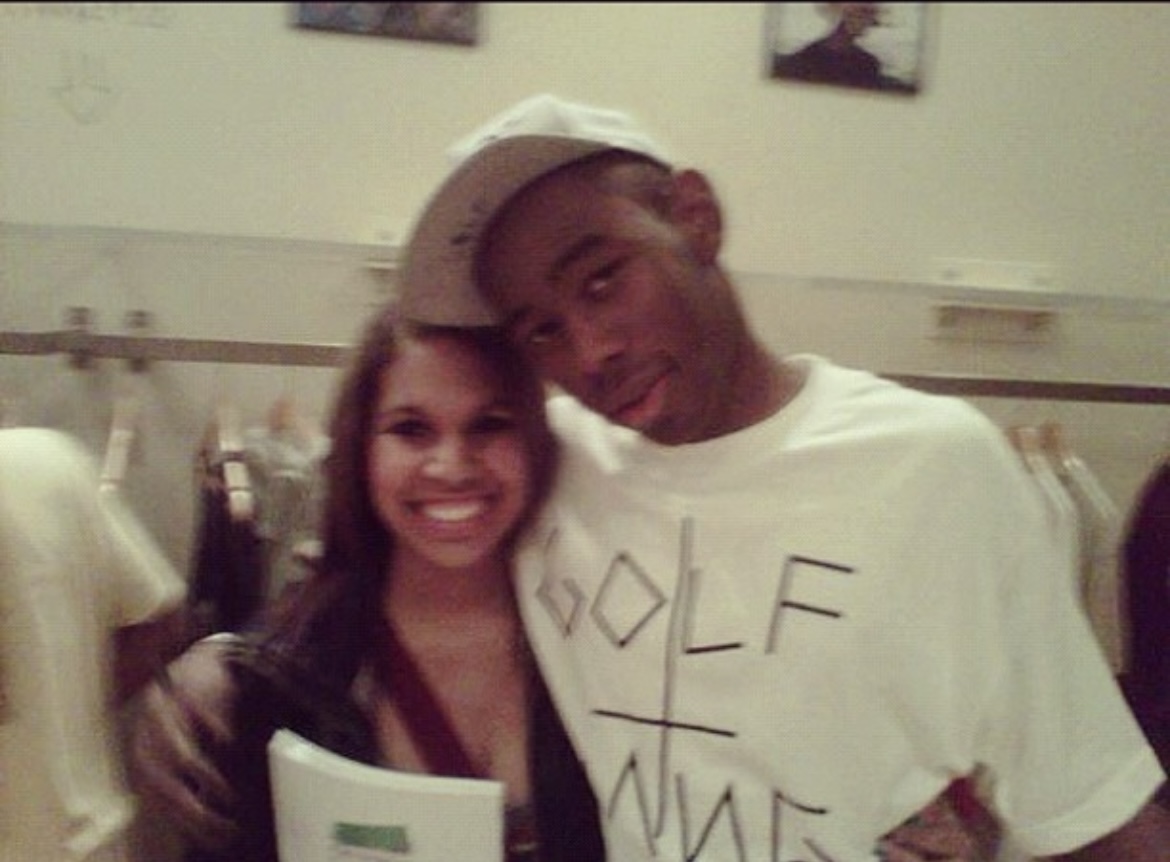
How Tyler, the Creator got me into college

When I was fifteen years old, I had an indescribable, all-consuming obsession with an up-and-coming rapper named Tyler, the Creator. I listened to every song, had notifications turned on for every one of his tweets, and watched every interview and vlog of his I could find. 

In October of that year, I waited in a six-hour line at the grand opening of his Odd Future store on Fairfax Avenue in Los Angeles, CA. When I finally reached the front of the line, I met Tyler. We took a picture, he told me I had pretty teeth, and I bought a photography book and tank top. For years, I never washed the shirt I was wearing while I met him. It was literally the best day of my life up until that point. 

This is the picture of Tyler & I (There was a no photo policy in the store but he made an exception for me, because I was practically hyperventilating, saying, "Someone take a picture of us before she passes out.") 

I saw a bunch of street banners advertising UCLA while waiting in line. I assumed the campus was close by, not knowing anything about LA's geography or traffic. That day changed the trajectory of my life and was the birth of my "dream school." My goal was clear: I would gain acceptance to UCLA, putting me in clear proximity to Tyler's store which would allow me to be around him often enough for us to fall in love and get married. 

The second part of the goal never came to fruition; I very rarely went back to his store. The first part of the goal, however, did come true on March 21, 2014. This became the new best day of my life. Little had I known, my unhealthy obsession with a rapper would lead to my acceptance to UCLA. 

Once I got to UCLA, I realized my journey there was unlike the rest of my peers. In the words of Claire Vaye Watkins, "All educations, [I] realized then, are not created equal." In The Ivy League was Another Planet, Vaye Watkins tells her college admission story. Growing up in rural Pahrump, Nevada, population 44,738, she explains, "By the time they're ready to apply to colleges, most kids from families like mine--poor, rural, no college grads in sight--know of and apply to only those few universities to which they've incidentally been exposed."

This blog by Professor Pruitt explores Vaye Watkins article in more detail.

Growing up in Merced, California, was similar in a lot of ways to Vaye Watkins in Pahrump but also very different. Merced is a mid-sized, agricultural city in the middle of the central valley, but it also the home of the University of California's newest campus, UC Merced and Merced Community College. Moreover, twenty minutes north is California State University (CSU), Stanislaus and fifty minutes south is CSU Fresno. It is a great privilege to grow up surrounded by so many options for higher education, one that many rural students don't enjoy.

For the most part, however, I learned of these schools because of proximity or incidental exposure, not because they put any effort into recruiting my classmates or me. Like Watkins' high school, the only recruiters that came to Merced High were military recruiters. And their efforts were rewarded. We loved the college-aged men coming to our school, getting us out of history class to go into the quad and engage in pushup and pull up challenges. They bragged to us about seeing the world, buying brand new Mustangs and Camaros, and making double the money for simply being married. Sarina Mugino discusses military recruitment, and military marriages, in more detail in this blog. At my high school graduation, a small group of us were going off to a university, but plenty of others stood to be honored for enlisting in the military. 

Ivy League schools were truly another planet. I couldn't even name any outside of Harvard and Yale. I often got Stanford confused with CSU Stanislaus. I knew absolutely nothing about the vast range of prestigious universities throughout the country.

I applied to eight schools because I qualified for a fee waiver that granted me four free CSU applications and four free UC applications. At seventeen, my choices were based on location. I knew practically nothing about any of the schools, but I knew UC Santa Barbara, UC San Diego, and San Diego State University were by the beach. I knew CSU Chico was known for parties. I knew UC Irvine, CSU Humboldt, and CSU Northridge were far enough away from my hometown that I could distance myself and begin healing from the difficult environment I grew up in. 

Outside of Tyler, the Creator, UCLA also had one thing no other school had. It had prestige. The day I proudly announced to my geometry class that I planned to go to UCLA I had no clue of its prestige or small acceptance rate. After my announcement, two of my classmates burst out laughing, telling me that "like 5% of people accepted there are Black" and I wouldn't qualify to join that small number. I will always remember my geometry teacher, Mr. Aguayo, for adamantly and immediately sticking up for me by saying his brother, "who was a lot less smart than me," graduated from there and Riki could, too. 

Unfortunately, Mr. Aguayo was an exception to the norm. It became a pattern for people to doubt my dream. Repeatedly, I was told I would not be admitted. These messages came from classmates, teachers, an assistant principal, and probably many more people behind my back. Eventually, I allowed the doubts to erode my enthusiasm until I stopped telling people my dream. In fact, by UCLA's decision day, I told all my classmates I wasn't going to check because I would never go to UCLA anyways. I will always regret waiting to read my acceptance until I was at home and all alone. I wish I had trusted myself more. 

In hindsight, the people who doubted me knew something I, very thankfully, had no clue of--the resources of the students I was up against. 

I took my SATs twice, with no studying beforehand. I had straight As, but from a low-funded, low-performing high school. Most shocking of it all, to me, is that little seventeen-year-old me submitted every part of my college applications through my iPhone because my family had no computer. I wrote my personal statement and scholarship essays in my notes app, copy and pasting straight from there to admissions portals. 

I've worked in college admissions since I was nineteen and I've seen over and over how unequal educations are. With my current company, students start their college preparation as early as middle school. They are assigned a tutor for every subject they can't get an A in. They begin our rigorous, years-long SAT/ACT prep. They are assigned a college counselor who studies their transcripts, extracurricular activities, interests, etc. and curates a perfect college list for them that ranges across the country. And, before the applications even open, essay coaches, like me, fine comb through every word on each and every one of their applications, using our CEO's essay writing formula, until each is polished to perfection.

I look back at my own college application efforts and I truly marvel that I ever stood a chance. 

In some ways, I think there is a privilege in growing up a world away from the Ivy Leagues. I still remember the unexplainable joy I got reading I was accepted into my first college, San Diego State. I ran to my mom's room and we both cried, repeating over and over, "we're going to college." She immediately asked me to send her a screenshot so she could brag on Facebook. For us, honestly, any college was a dream.

But I was lucky enough to grow up in California. Even my "safety" schools were great schools. There are many students for whom UCs and CSUs are on another planet, and many for whom even community college is in another universe. Watkins ends her article with a very powerful question, "...is it any wonder that students in Pahrump and throughout rural America are more likely to end up in Afghanistan than N.Y.U.?" From my experience, there is no wonder in this at all. 

This post, by Geovanna, goes into detail about other risks that hold rural students back from receiving college educations.

Labels: , , ,

Thursday, October 6, 2022

Finding a way home

I firmly believe that we all belong somewhere. We belong to those who are part of our history. It is impossible to think of oneself without thinking of our family, friends and places that saw us grow up. Even when trying to define ourselves we instinctively think of our origins. That's what lets us know who we are.

Being alone in a country far away from your own leaves you a lot of time to think. It seems strange to me, however, that it has taken me just over 22 years to understand the meaning of the words my mom used to tell me when I was little (paraphrasing "The Little Prince" which used to be her favorite story and she read it all the time to me and my brother)...:

"It is only with the heart that one can see rightly, what is essential is invisible to the eyes."

Only now I can realize how right she was (I guess it's kind of true that moms are never wrong).

How ironic life is, maybe even a little cruel, because I understand it now. Now that I am almost 5000 miles away. Now that what I miss most about my country is not my house, where I had a room to myself, nor my car, much less going out to eat at expensive restaurants or having my mother to do the cleaning and cooking for me. I always thought those would be the most difficult when I came here to study, but honestly I haven't even thought much about any of those memories since I arrived in California.

Now, if you ask me what I really miss about Chile, I don't have to think extensively about it, the answers are clear. I miss with all my heart hugging my mom and having her make me feel like everything is okay, just like when I used to run into her arms after kindergarten. I miss going to my aunt's house on Sundays and cooking a mariscal together as a family and staying there until we have once together. I miss sitting with my cousins at the bonfire they have in their backyard and talking about everything and nothing at the same time. I miss watching my soccer team's games and even the euphoric screams of my dad and brother. I miss arriving home and having my dog, Tomás, waiting for me so we can go for a walk together. I miss going out with my friends to do nothing and laugh about life. I miss feeling part of a community. I miss the people of Chile and lo muy de piel that we are. And yes, it took me a while, but I finally understood that what is really important is not seen, but felt, right in the chest.

The first picture is Tomi wearing our soccer team shirt and the second picture is me walking with Tomi.

Erica Violet Lee points out that we must redesign the word wealth from our experiences. When I read it I thought nothing had ever made so much sense to me. I always thought that to be rich was to have a car, a big house and a great job, but now that I think about it, I had all that in Chile, and I never felt happy or different because of it. Maybe, if no one told us what it meant to be rich. Maybe, we would live in a utopian world there was no capitalism and its prevailing ideas of what success or wealth is. Only then could we each give it our own definition, we would finally realize how lucky we are and that money has nothing to do with it most of the time.

I delusionally thought that I would be "happier" in the United States and at the same time I was afraid of feeling very different from my peers. This can be attribuited to the standard of living in a developed country being very different from many Latin American countries. However, on the contrary, my experience here has made me realize how truly rich I am and my people are.

Crucially, Lee points out that she no longer wants to spend time and energy on making her intellect more readable for the university. This is something I emphatize with, I've spent years striving to get here to achieve "success", which will eventually lead to wealth. I have spent so much time and effort searching for something that didn't really belong to me, because that's not my definition of abundance, at least not the one that fulfills me.

Now I contemplate my experiences growing up, and think that if I had understood what my mom meant when she read "The Little Prince" to me as a child, I would have done so many things differently before I left Chile. I would have taken care to give my mom tighter hugs, to stay a little longer at the table on Sunday with my family, to extend the conversation at the bonfire with my cousins, to enjoy the games and even the euphoric shouts of my dad and brother, to take longer walks with my Tomi, to enjoy laughing and even doing nothing with my friends.

Maybe I would have understood that, for me, being rich and feeling rich has to do with belonging to a place and its people, as I belong to them, and they belong to me. Undoubtedly, the right way to see is with the heart.

*Once: once refers in Chile to a light dinner or evening snack that consists of coffee or tea, and bread with butter, cheese, marmalade, or other accompaniments.

*Ser de piel: literally means being made of skin, but in Chile means when a person is affectionate, likes to hug and have physical contact with others. Someone who likes to cuddle others a lot to show their affection.

Labels: , , , ,